Akeley’s disappearance and the discovery of his artificial face and hands
The Colour Out of SpaceAkeley’s disappearance and the discovery of his artificial face and hands is the decisive revelation in Albert N. Wilmarth’s final visit to the Akeley farmhouse: the man Wilmarth expects to find is gone, while objects that appear to reproduce his face and hands remain among the garments he has discarded. A fresh brain cylinder bearing Henry Wentworth Akeley’s name deepens the possibility that the absent man’s identity has been transferred or imitated, but the evidence stops short of settling what happened. The scene makes absence itself the horror: Wilmarth sees no monstrous transformation, only familiar objects whose arrangement forces him to question who, or what, has been present.
The Search in the Study
Wilmarth enters the dark study cautiously, after finding Noyes asleep in the living room across the hall. He has a flashlight, a valise, and a revolver, and expects to find Akeley in the large corner chair he understands to be his host’s customary resting place. Instead, the first striking object is on the centre-table: a brain cylinder fitted with sight and hearing attachments, with a speech-machine close at hand, ready to be connected. Wilmarth recognizes it as the encased brain he had heard speaking during the earlier conference.
The cylinder is not merely an unfamiliar piece of machinery. It is fresh and shiny, and bears Akeley’s name; Wilmarth had noticed it on a shelf earlier that evening and had been told not to touch it. Its sensory attachments make the device seem capable of detecting him through the flashlight beam and the creaking floor. He considers connecting the speech-machine, but does not dare. In retrospect, he regrets not making it speak, because it might have answered questions about the room and the identity of its occupants. Yet the possibility that it could have revealed something terrible leaves his restraint uncertain even to himself.
The Empty Chair and the Missing Man
When Wilmarth turns the light toward the corner, the easy-chair is empty. Akeley’s familiar dressing-gown trails from the seat to the floor; the yellow scarf and the large foot-bandages Wilmarth had previously found strange lie nearby. Their presence makes the absence harder to explain: these are garments and coverings associated with Akeley, but they have been shed without the man himself appearing anywhere in the chair.
The room also lacks the queer odour and sense of vibration Wilmarth had noticed before. He recalls that both had been strongest near Akeley, and that they had otherwise occurred only in the room with him or immediately outside its doors. Their disappearance therefore accompanies the empty chair, linking the former sensations to Akeley’s presence without explaining their source. The clue is circumstantial, not a solution; it sharpens Wilmarth’s suspicions while leaving him unable to determine what has changed.
The Face and Hands
After the flashlight has swept the room, it returns to the chair. Only then does Wilmarth notice three objects partly concealed by the loose folds of the dressing-gown. He stresses that they are not visually horrifying in themselves. Their effect lies in what they imply. They are ingenious constructions, fitted with metallic clamps seemingly intended to attach them to organic structures, though Wilmarth cannot bring himself to imagine the precise use of those attachments.
The objects are the face and hands of Henry Wentworth Akeley, rendered with microscopic subtlety and described as resembling—or possibly being identical to—his features. Their craftsmanship permits a desperate alternative: perhaps they are wax models made by a master artist. Wilmarth hopes that this is all they are, but his fear points toward a more disturbing possibility. The face and hands do not prove what happened to Akeley, nor do they reveal who occupied the study before his disappearance. They convert the familiar likeness of a person into evidence that can be copied, detached, and mistaken for the person himself.
Flight and Unresolved Evidence
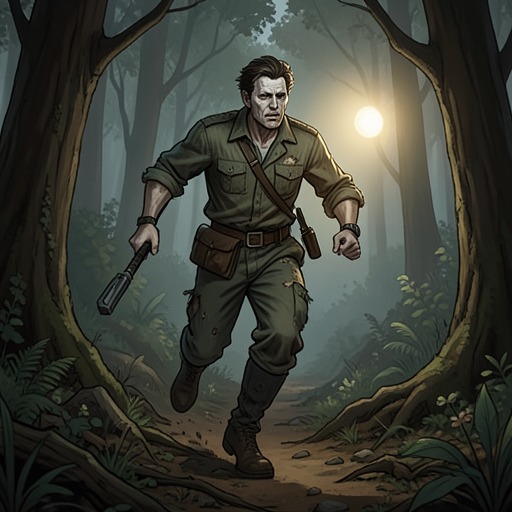
Wilmarth’s discovery ends not in explanation but in flight. His muffled shriek disturbs Noyes without fully waking him; the sleeping man’s continued snoring is among the last sounds Wilmarth hears inside the farmhouse. Wilmarth escapes with his flashlight, valise, and revolver, reaches the old Ford in the shed, and drives through the moonless night until he reaches Townshend. The scene’s objects remain behind, and no confrontation gives him a chance to test the cylinder or question Noyes.
Later investigators do not find the three constructions Wilmarth saw in the chair. That absence compounds the uncertainty surrounding the account: the objects that most strongly support his suspicions are also unavailable for independent examination. Wilmarth admits that he sometimes half accepts the explanation that his experience arose from dreams, nerves, or delusion. His retrospective doubt does not erase the details of the scene; instead, it makes the difference between observation and inference central to the episode. The cylinder bears Akeley’s name, the clothes lie discarded, the chair contains a likeness of Akeley’s face and hands, and Akeley himself is nowhere to be found. What those facts mean remains the question the escape cannot answer.